
Vytautas Carr’s Custodianship of the Secret
Operation NapoleonCarr’s arc traces a lifetime spent inheriting and defending a buried wartime secret, from managing the glacier recovery to deciding that human witnesses and even his own operative are expendable.
increasing Bearing strength in each event
 decreasing
Bearing strength in each eventdecreasingThe Inheritor
Taking Charge of the Secret
From Soldier to Intelligence Chief
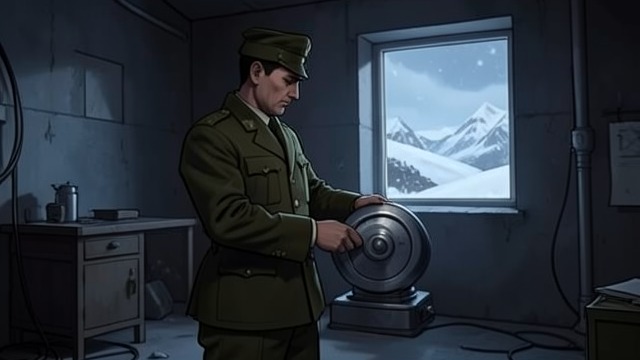
Vytautas Carr rises through the military from his Lithuanian immigrant childhood into active service, intelligence work, and leadership. When he takes over the organization in the early 1970s, his predecessor gradually briefs him on the German aircraft hidden in Vatnajökull.
Carr learns the secret’s history and the procedure for responding if the wreckage ever reappears. Knowledge is tightly controlled and passed from one officeholder to the next, making Carr not the original architect but a custodian of a decision he did not make.
A Duty Renewed
For decades, the organization monitors the glacier first through surveillance aircraft and later by satellite. Carr reviews the contingency plan every few years and accepts that preserving the secret is part of his job.
The arrangement gives him authority, but it also binds him to an inherited crisis. When improved imagery reveals a dark object on the ice, Carr immediately recognizes that the old procedure has become active again.
The Recovery Ordered
Turning Discovery into an Operation
Mobilizing in Secret
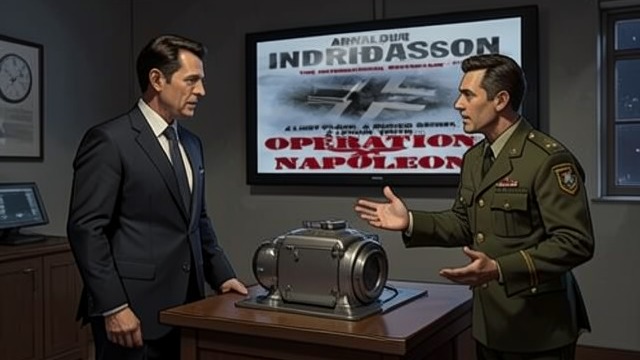
Carr orders Ratoff to lead a covert expedition to Vatnajökull and arranges the use of Delta Force, transport aircraft, and specialized equipment. He also places personnel in the embassy and prepares an explanation for Icelandic officials, seeking to limit knowledge of the operation.
The decision is driven by the fear that the glacier has exposed a secret kept for more than half a century. Carr regards public discovery not as an opportunity to clarify history but as a political danger that must be contained before the wreck leaves Iceland.
Securing Political Cover
When challenged by the U.S. Secretary of Defense, Carr presents a false account centered on the Walchensee gold and the risk that it came from Holocaust victims. The story persuades the secretary to authorize the operation and to keep the President uninformed until it is complete.
Carr also gives Icelandic officials a misleading account of the plane and asks for cooperation without revealing the real reason for the mission. His ability to control the narrative allows the recovery to proceed, but each lie creates new exposure when events on the glacier become visible.
Control Under Pressure
The Mission Begins to Fracture
Watching from Washington
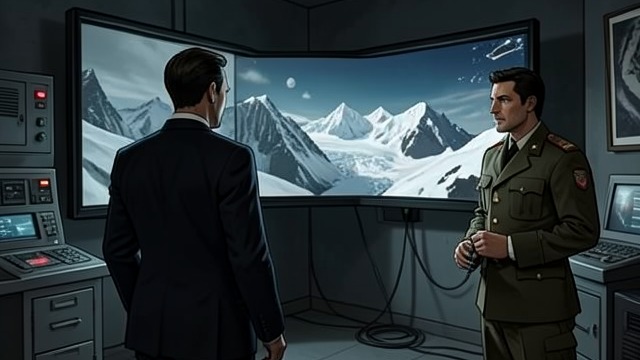
Carr follows the excavation through satellite imagery from Building 312. The plane emerges from the ice, and he watches the operation progress while knowing that the aircraft’s cargo and documents are more dangerous than the recovery team’s public explanations suggest.
When the fuselage breaks open, the discovery of the bodies confirms that the mission is entering its decisive stage. Carr wants the wreckage, the papers, and every trace of the operation removed before Icelandic authorities can force a fuller account.
The Cost of Secrecy
Ratoff reports that two Icelandic rescue-team members entered the area and that one has a sister in Reykjavík. Carr objects to the danger posed to Icelanders, but he does not stop the operation or remove Ratoff from command.
As the rescue team and Icelandic officials move closer, Carr’s control depends on increasingly strained cover stories. The man responsible for preserving secrecy has to choose between protecting people and protecting the institution’s inherited secret, and he repeatedly puts the latter first.
The Secret Leaves Iceland
Closing the Operation
Retiring the Evidence
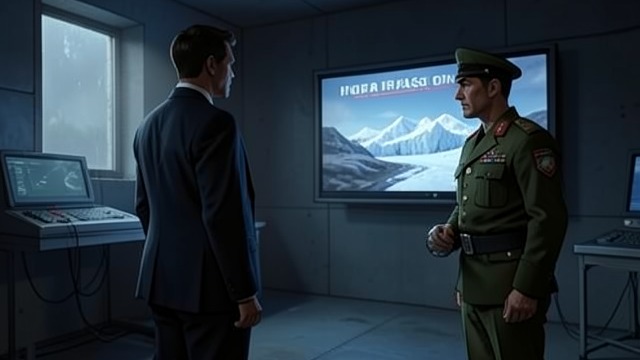
Carr arrives in Iceland as the recovery becomes an urgent diplomatic problem. The Icelandic government challenges the American account after the rescue team reports armed soldiers, deaths, and obstruction; meanwhile the press begins connecting the glacier and the military movements.
Carr nevertheless gets the wreckage onto the C-17 and prepares to take it to the United States. His priority is to make the aircraft and its papers disappear from Iceland, where eyewitnesses and official scrutiny might otherwise converge.
Turning on Ratoff
When Ratoff presents blank papers and demands a deal, Carr refuses. He treats the operative’s knowledge and attempted blackmail as another danger to be eliminated rather than as a reason to negotiate.
Carr’s men torture Ratoff and push him through the aircraft’s open ramp. Carr has not merely abandoned a subordinate; he has confirmed the logic of the whole operation, in which the people who serve secrecy are themselves disposable once they threaten it.
The Historian Without a Record
Power Through Erasure
A Deliberate Account of the Past
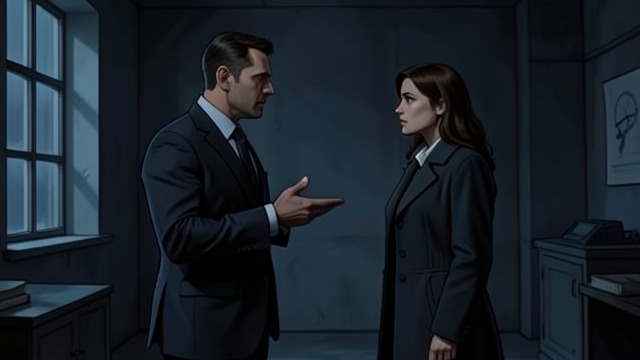
Carr tells Kristín that truth and lies are tools rather than moral opposites, and describes his work as the correction of history for institutional purposes. His examples show how readily he turns uncertainty about public events into an argument for doubt about everything.
He does not need Kristín to accept his account; he needs her to understand that the machinery of government can make testimony ineffective. The threat against her and her companions ensures that the secret is defended not only through denial but through fear.
A Legacy of Silence
Carr intends to retire once the operation is complete, imagining that the glacier affair can be closed as an insignificant footnote. Yet the people harmed by the recovery and the papers that survive make that closure less complete than he assumes.
His fate is defined by custodianship rather than discovery: he inherits a plan, protects it through deception, and leaves behind no public accounting of what it meant. By the end, his success lies not in proving the official story true, but in making the competing truth difficult to establish.
Early 1970s
27–29 January 2000
30 January 2000
31 January 2000
After the C-17 departs Iceland
